New survey indicates increase in gay blood donors since 2021 rule change
New analysis indicates large increase in the number of gay men donating blood in England over the last decade, following changes to Government blood donation guidelines.
The ‘For the Assessment of Individualised Risk (FAIR)’ steering group – made up of scientists, doctors, donors, recipients, academics and advocacy group members – has been surveying the reported sexuality of blood donors.
A new FAIR survey of 8,744 male donors has found 7.5% reported their sexual orientation as bisexual, gay, pansexual, queer, bicurious, or sexually fluid. (1)
That compares to 2014, when a comparable survey found only 1.8% of male blood donors reported ever having had sex with men.
While the two surveys did not use exactly the same methodology, FAIR researchers think they do provide good evidence many more gay and bisexual men are donating blood since the guidelines were changed and became more inclusive.
At the time of the 2014 survey, men could not donate blood if they had had sex of any kind with a man within the last 12 months. In 2017, that was changed to three months. In 2021 that was changed so that people of all genders could not donate blood if they’d had anal sex in the last three months, based on risk data.
The work which enabled the 2021 change was done by the FAIR steering group, which was set up at the direction of the Government. FAIR reviewed the latest evidence and gathered data to see if the guidelines could be safely changed to make donor assessments more personalised to each individual. FAIR’s recommendations were accepted by the Government and then introduced by NHS Blood and Transplant in June 2021. (2)
NHSBT takes around 1.5m blood, plasma, and platelet donations a year, and needs nearly 200,000 people to register as new donors each year.
Thomas' story
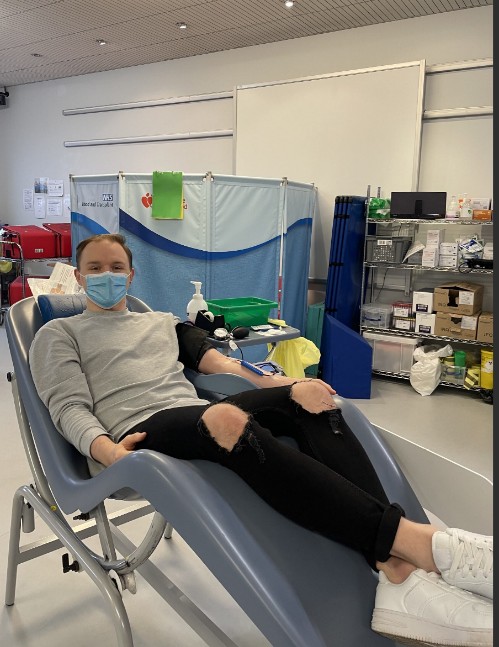 Thomas Yates, a gymnastics coach from Westhoughton in Greater Manchester, was able to donate for the first time in 2021 and has now donated 16 times. He is engaged to Ashton David Hall.
He was determined to donate blood, inspired by his donor parents and the memory of his grandfather who needed weekly transfusions for leukaemia.
"I feel very passionate about it – you are literally saving someone’s life with one hour of your time, it's something we should all do as part of the human race," said Thomas.
"I went to donate in 2018 knowing I wasn’t able – even though I was tested and had no infections or STDs but morally I could not go through with it, which was the right thing to do, but I was left incredibly upset. I felt it was another way queer people are marginalised. I was so fit and healthy.
"I booked my first donation in 2021 almost as soon as the rules changed. I donate at the Plymouth Grove donor centre in Manchester.
"I felt elated afterwards, proud that I was able to donate, pleased the rules had changed, happy, overjoyed – even speaking about it now, I am getting a little teary. It was such a great day.
"My journey has been quite tumultuous, a love and hate experience. I could have done nearly 80 donations by now had we as queer people been able to donate sooner.
"Honestly, it’s so easy to donate. You complete the form, have a drink, have the screening chat, and then go and donate blood. The staff are so friendly
"I am pleased the surveys show evidence more queer people are donating. It think it helps change perspectives."
Register as a blood donor on our Give Blood website
Statements
Press release notes
- Surveys figures are within a confidence interval of 6.7% to 8.4%. The figures are due to be reported in a research paper
- FAIR was set up at the beginning of 2019 at the request of the Department of Health and Social Care. The steering group includes representatives from the 4 UK blood services, LGBT+ groups, medical, scientific and academic experts, and patient and donor representatives. FAIR's work has included conducting focus groups with gay and bisexual men. It examined existing epidemiological data and research on transmission risks. It surveyed thousands of current and potential new blood donors. It also held a mixture of workshops, focus groups and interviews with groups such as blood donation session staff, current blood donors and potential new donors. Based on FAIR’s evidence based recommendations, new donor assessment criteria which enabled more gay and bisexual men to donate blood were approved by the Department of Health and Social Care and then introduced by the UK’s blood services. More information is available on our Give Blood website.