
Largest ever trial of interventions for blood donor vasovagal reactions (feeling faint and fainting) shows no benefit from four additional interventions
The results of STRategies to Improve Donor ExperienceS (STRIDES), the largest and most comprehensive randomised controlled trial ever to evaluate strategies to prevent faints in whole blood donors, suggest standard practices may not benefit from additional interventions.
 The findings have just been published online by The Lancet Haematology [open access].
Worldwide, more than 100 million whole blood donations are collected annually to support healthcare. Donation is generally regarded as a low-risk procedure. Feeling faint and fainting (i.e., vasovagal reactions [VVRs]) are the most common acute systemic complication.
Blood services worldwide have implemented varying strategies to prevent VVRs. There is, however, limited reliable evidence about how to prevent VVRs. Interventions were based on observational studies, small-scale randomised trials and meta-analyses.
STRIDES is an unusually large and robust study, involving more than 1.3 million donors and four million donations across 73 NHS Blood and Transplant donation sites in England between November 2019 and November 2022. (1)
STRIDES tested 4 additional interventions:
- Isotonic hydration before donation: 500ml isotonic drink vs standard practice of 500ml plain water.
- Time on donation chair after donation: 3-minutes before standing vs standard practice of 2-minutes.
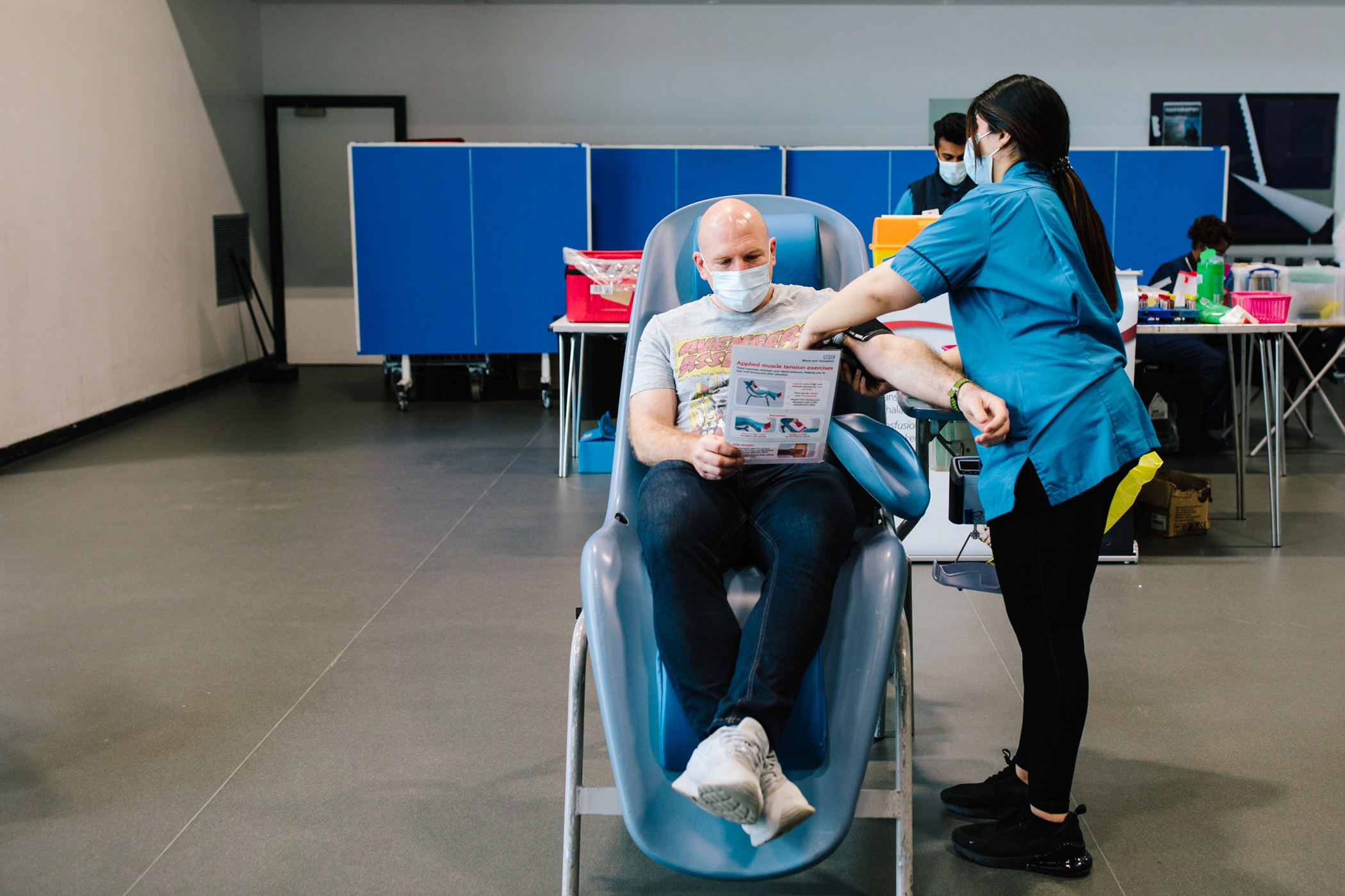
- Modified applied muscle tension (AMT): new AMT vs current standard practice of AMT.
- Psychosocial intervention: preparatory materials vs current standard practice of nothing.
None of the interventions clearly reduced the primary outcome, which was the number of in-session VVRs with loss of consciousness, when compared to NHSBT’s standard practices. (2) The results, combined with prior limited and inconsistent evidence, suggest that routine use of additional interventions beyond standard practices may not meaningfully reduce VVRs in whole blood donors.
The STRIDES study was sponsored by NHS Blood and Transplant and carried out by the NIHR Blood and Transplant Research Unit (BTRU) in Donor Health and Behaviour at the University of Cambridge. (3)
Press release notes
- The results from the STRIDES trial are unusually robust because the trial has combined several major strengths. First, STRIDES concurrently and efficiently evaluated four of the most promising interventions to prevent VVRs, minimizing any bias by employing cross- over, stepped-wedge, and factorial approaches. Second, it included almost all 1.4 million whole blood donors attending 73 NHSBT sites over a three-year period, meaning the trial was both powerful and widely generalisable to blood donors in England. Third, the trial was embedded in a real-world blood donation setting, enhancing, for example, data completeness and accuracy in the ascertainment of VVRs through linkage with NHSBT’s routine adverse event reporting system while avoiding recall biases.
- During the trial period, 4,388 VVRs with loss of consciousness and 65 60,517 total in-session VVRs (i.e., with and without loss of consciousness) were recorded. Compared to standard practices, none of the interventions clearly reduced the primary outcome (joint p-value= 0.213): odds ratio of 0.98 (95% CI, 0.92-1.04) for isotonic drink, 0.99 (0.92-1.06) for extended chair rest, 1.12 (1.00-1.16) for modified AMT, and 1.03 (0.93-1.14) for psychosocial intervention. Absolute event rates per 10,000 bled were 10.7 without intervention and 10.5 with intervention. Findings were similar for total in-session VVRs with higher absolute event rates.
- The NIHR Blood and Transplant Research Unit (BTRU) in Donor Health and Behaviour (formerly Donor Health and Genomics) at the University of Cambridge is funded by the NIHR and is a partnership between the University of Cambridge and NHS Blood and Transplant (NHSBT), in collaboration with the University of Oxford and the Wellcome Sanger Institute. www.donorhealth-btru.nihr.ac.uk