
COBALT
Cardiorespiratory Optimisation By Arteriovenous fistula ligation after transplantation – the COBALT feasibility trial.
Chief investigator: Mr Gavin Pettigrew
Primary sponsor: Cambridge University Hospitals NHS Foundation Trust and the University of Cambridge
Funder: NIHR Research, Addenbrooke’s Kidney Patient Association (AKPA), and Cambridge University Hospitals NHS Foundation Trust

Summary
Should we disconnect haemodialysis fistulas in patients after they have been transplanted successfully: the COBALT feasibility study (Cardiorespiratory Optimisation By AVF Ligation after Transplantation).
Study hypothesis
Objectives of this study:
- To conduct a feasibility study involving six centres that mirrors a proposed Randomised Controlled Trial (RCT)*, but that uses pre-defined cut-offs with regards to patient recruitment and retention rates to justify progression to the RCT.
- To understand patients’ and healthcare professionals’ perceived acceptability of the proposed trial design and processes, with a view to planning strategies to optimise recruitment and retention for the main RCT.
- To assess feasibility and acceptability of a Cardiopulmonary exercise test (CPET) in the kidney transplant population, as judged by the proportion of participants who successfully complete both tests.
- To assess patient compliance with wearing a wrist accelerometer (activity sensor).
*Proposed RCT hypothesis: In stable renal transplant patients, fistula disconnection improves cardiorespiratory fitness, thereby increasing patients' activity levels and improving quality of life.
Study design
A randomised, open-labelled, interventional feasibility study of a proposed multicentre randomised controlled trial.
Trial Results Summary for Participants
Should we disconnect haemodialysis fistulas in patients after they have been transplanted successfully? The COBALT feasibility trial.
If you took part in the COBALT trial alongside your routine kidney transplant care in 2022/2023, thank you for your support. We've included a summary of the trial and the results.
Why did we run this trial?
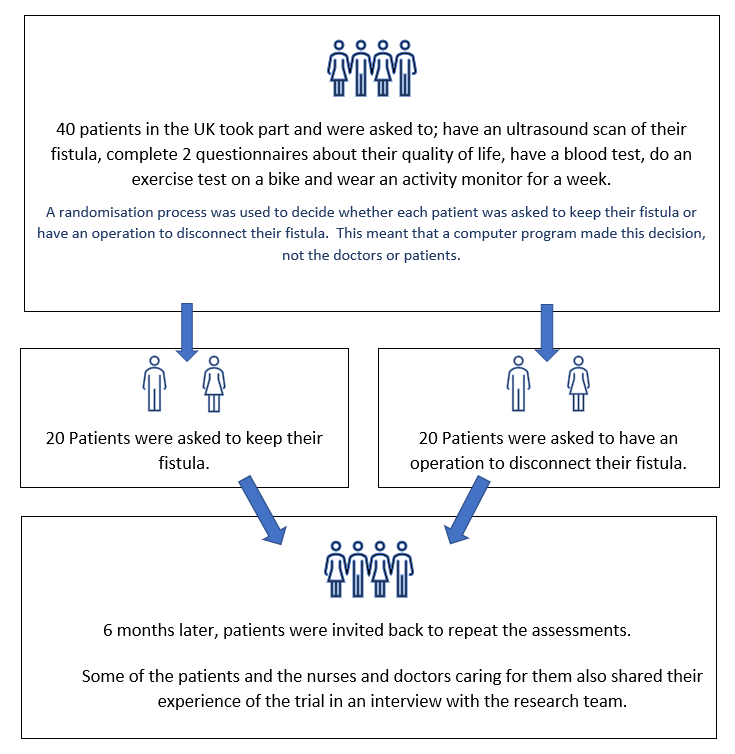
A team of UK doctors, nurses and researchers want to find out whether patients with good kidney transplant function could benefit from having their arteriovenous fistula disconnected. It would take a big trial of about 400 patients to get a clear answer to this question. So first we ran this smaller trial called COBALT to see whether patients would want to be involved and how they found taking part in the trial.
What have we learnt?
It was harder than we hoped to identify kidney transplant recipients with a working fistula. We think this is because after transplantation, there is less focus on whether a fistula is still working, and this information is not regularly recorded in clinic notes.
Patients had mixed views on managing their fistula after transplant. Some felt protective of their fistula in case they needed dialysis in the future, whereas others liked the idea of having it disconnected. Of the 20 patients who were asked to have their fistula disconnected, 7 didn't go ahead with the operation.
The exercise bike test was quite challenging. In this test patients had to cycle progressively harder to the very maximum of their ability: this provides a very good measure of how fit that person is, and how well the heart works. Not all the patients were able to reach their maximum. However, the participants found the wrist-worn activity monitors very easy to wear.
Overall, we did find enough patients to take part, but 13 of the 40 didn't manage to complete the trial.
In a small trial like COBALT, we don't have enough data to be sure about the effect of what we are testing. Whilst COBALT could not provide strong evidence of any benefits of fistula disconnection, we have seen some interesting trends:
- In the exercise test, we could not see significant differences in how well patients heart and lungs coped with exercise.
- We found that patients who had their fistula disconnected reported being more physically active 6 months after the operation, than when they started the trial.
- We tested everyone's blood for levels of NT-pro BNP. This is used as an indicator of how much strain the heart is under. In most of the patients who had their fistula disconnected, we saw the amount of NT-pro BNP in their blood go down. But in patients who kept their fistula, the amount generally stayed the same or slightly increased. This suggests that fistula disconnection could help reduce strain on the heart.
Completing the trial was not always straightforward for patients, and we would likely encounter the same issues in a larger trial. It would be challenging to design a larger trial that would be acceptable to patients and clinicians. Based on the results of the COBALT trial, we believe a larger trial may not provide strong evidence of any benefits or disadvantages of disconnecting fistulas in kidney transplant patients.
This research would not have been possible without your involvement.
We are very grateful to you for coming in for the trial assessments and sharing your experience. By taking part in this trial, you have contributed to better care for transplant patients in the future.
With thanks from,
Prof. Gavin Pettigrew
Honorary Consultant Transplant Surgeon at Cambridge University Hospitals NHS Trust